11 min to read
The $6.3B Binance Heist Began on One Laptop: What to Do Now
North Korea's TraderTraitor did not steal keys. It made the exchange's own systems sign. Here is what every business should learn.
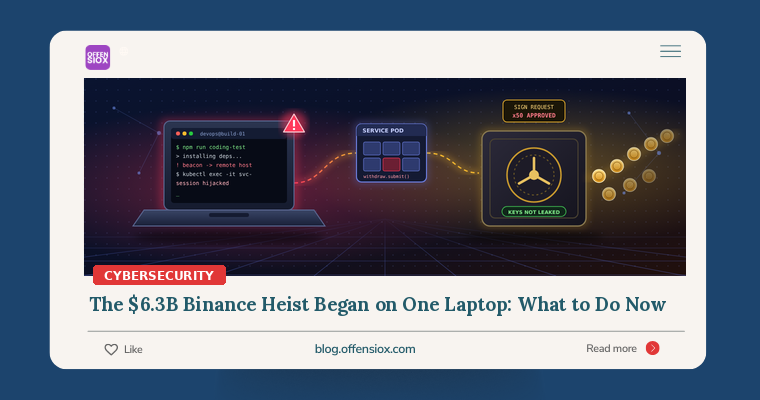
The largest crypto theft on record did not start with a smart-contract bug or a leaked seed phrase. According to Binance’s own initial investigation, it started with one DevOps engineer’s laptop. From there, an attacker reached a service container and got Binance’s hot-wallet systems to sign withdrawals of roughly $6.3 billion. On 31 October the FBI attributed the theft to North Korea’s TraderTraitor group, the same cluster behind the $1.5 billion Bybit heist in February 2025.
You do not need to run a crypto exchange for this to matter. Almost every modern business has engineers whose laptops can reach production, CI/CD pipelines, cloud consoles or payment systems. This post breaks down what is known so far, what is still unclear, and a prioritised plan to make sure your own “one laptop” cannot become your worst day.
TL;DR / Key takeaways
- What: On or about 29 October 2026, attackers drained about $6.3B in crypto from Binance hot wallets. Binance says a compromised DevOps engineer’s laptop gave access to “a service container” used to submit unauthorized withdrawals, and that it found no evidence of a private key leak.
- Who: The FBI attributes the theft to North Korea’s TraderTraitor, and asks crypto providers to block 628 addresses linked to it. TRM Labs and Chainalysis also point to the DPRK with high confidence.
- Impact on users: Binance says it will cover all losses. By 2 November it said about 95% of stolen assets had been replaced and withdrawals were reopening in phases. Scammers are already pushing fake “compensation” offers.
- The lesson: The attacker abused trusted signing infrastructure, not keys. Privileged engineer endpoints, container access paths and automated approval systems are now front-line targets.
- Do first: Inventory who can reach production signing or payment systems from a laptop, require phishing-resistant MFA and just-in-time access for them, and add independent, out-of-band limits on high-value automated transactions.
Timeline
Details are still emerging and Binance has not yet published its promised technical post-mortem. The timeline below uses only what Binance, the FBI (as reported) and blockchain analytics firms have stated.
| When (2026) | What happened |
|---|---|
| Before 29 Oct | TRM Labs says the attacker’s preparation began at least 36 hours before the theft. |
| 29 Oct, 20:20 UTC | Per TRM Labs, the operator submits “a single transaction containing 50 authorizations”, each signed by the Binance hot wallet and pointing to a sweeper contract. About 3 minutes 24 seconds later, one transaction moves 167,464 ETH and 63 tokens, including 1.615 billion USDT. |
| 30 Oct | Binance announces the incident, suspends withdrawals, revokes the affected address authorisation and says about $3B has been frozen on-chain. Tether, Circle and others freeze stablecoins. |
| 31 Oct | The FBI publishes an alert naming TraderTraitor and listing 628 addresses (608 Ethereum, 19 Bitcoin, 1 Solana). Binance says 90% of stolen assets have been replenished. |
| 1 Nov | Withdrawals begin reopening in phases, by network and asset type. |
| 2 Nov | Binance adds fiat withdrawals in more currencies and says about 95% of stolen assets have been replaced with its own funds. |
Estimates of the total differ slightly by firm and pricing time: Binance says about $6.3B, Chainalysis $5.912B at the time of theft, TRM about $6.36B, and Elliptic $6.43B.
How the attack worked (what we know, and what we don’t)
What Binance has confirmed
Binance’s official update is short and specific:
“Binance’s initial investigation suggests that the security incident may involve a compromised DevOps engineer’s laptop, which allowed an attacker to gain access to a service container and submit unauthorized withdrawal transactions.”
It added: “We have found no evidence of any wallet private key leak.” Co-CEO Richard Teng later stressed that “the attacker did not simply use one engineer’s permissions, and this was not a single ‘one-click’ action,” and Binance said its investigation had “uncovered additional points of breach.” In other words, the laptop was the doorway, and the attacker moved further inside before striking.
What analysts infer
Blockchain analysts reached the same conclusion from the on-chain evidence. TRM Labs said “the most likely explanation is that the attacker gained the ability to make Binance’s hot wallet signing system sign transactions of its choosing across chains.” Elliptic put it more plainly: “Rather than stealing Binance’s private keys, the attacker appears to have been able to get Binance’s own systems to sign transactions on their behalf.”
That distinction is the heart of this incident. Many organisations treat key protection (HSMs, MPC, cold storage) as the finish line. But if an attacker can sit in front of the signer and feed it requests that look legitimate, the keys never need to leave the vault.
How was the laptop compromised?
Not yet stated. Binance has not said how the engineer’s laptop was breached. Elliptic suggested the “likely use of social engineering to trick employees into executing malware under the pretext of a coding test or a bogus project”. That is analysis, not a confirmed finding, but it fits TraderTraitor’s history. In the 2025 Bybit case, Safe{Wallet} said the attack “was achieved through a compromised machine of a Safe{Wallet} developer”, and the attackers then swapped in malicious JavaScript that targeted Bybit’s multisig wallet. Halcyon’s Cynthia Kaiser summed up the pattern: “manipulating people and trust continues to be the most effective method to obtain access to target networks.”
The common thread across both heists is clear. TraderTraitor goes after the developers and operators who have privileged access, then abuses the systems those people are trusted to run.
Am I affected?
- Binance customers: Binance says “User funds are safe” and that losses will be covered from its SAFU fund and company funds. Withdrawals are reopening in phases; check status only through official Binance channels. You do not need to “claim” anything.
- Crypto exchanges, wallets, DeFi, bridges, OTC desks and payment processors: The FBI asks you to block transactions linked to the 628 TraderTraitor addresses. Make sure your compliance and analytics tooling has ingested that list, and watch for deposits derived from those addresses.
- Any company whose engineers can reach production from a laptop: You are in the same threat model. That includes fintechs, e-commerce platforms with payment integrations, SaaS providers and software vendors, the kind of businesses OffensioX works with across Pakistan and the region.
- Everyone: Expect phishing that uses this story as bait. Fake posts promise a “$150 compensation reward” to be claimed “through the Binance app”; a Binance team member said these “are fake and the information in them is false.” Changpeng Zhao’s warning was blunt: “Scammers on over drive now. Be careful.”
What to do: a prioritised checklist
Immediately (today)
- Warn your staff and customers about the scams. Send a short notice: no legitimate exchange will ask for a seed phrase, a password or a “verification” transfer to release compensation.
- If you handle crypto, load the FBI address list into your transaction-monitoring and sanctions tooling and block flows with or derived from those addresses.
- List who can reach your crown jewels from an endpoint. Name the people and devices that can touch production signing services, payment APIs, cloud admin consoles, CI/CD secrets or
kubectl execinto production. This list is usually longer than expected. - Re-brief engineers on fake recruiter and “coding test” lures. Elliptic’s working theory is exactly this lure. Make it policy that take-home tests and unknown repositories are only ever run inside a disposable VM or cloud sandbox, never on a work laptop.
This week
- Enforce phishing-resistant MFA and device trust (FIDO2 security keys or platform passkeys, plus managed-device checks) for every path into production. Stolen session cookies from an infected laptop should not be enough.
- Move to just-in-time, time-boxed privileged access. Standing admin rights on a laptop are what turn one infection into a breach. Require an approval and a ticket for production shell access, and expire it automatically.
- Put independent limits in front of automated signers and payment systems. Velocity caps, per-transaction and per-hour value thresholds, allow-listed destinations, and a second, out-of-band human approval for anything unusual. The Binance theft moved billions in minutes. A limit that the compromised system itself enforces is not independent.
- Hunt for the early signs. Start with the queries below and tune them to your environment.
Developer tools spawned from downloaded projects (Microsoft Defender for Endpoint, KQL): look for Node, Python or package managers running from Downloads or temp folders on engineer devices, a common pattern when someone runs an untrusted “test project”.
DeviceProcessEvents
| where Timestamp > ago(14d)
| where FileName in~ ("node.exe","python.exe","python3.exe","npm.cmd","npx.cmd","pip.exe")
| where ProcessCommandLine has_any (@"\Downloads\", @"\AppData\Local\Temp\", @"\Desktop\")
| summarize count(), cmdlines ~|=| make_set(ProcessCommandLine, 10)
    by DeviceName, AccountName, FileName
| order by count_ desc
Interactive access into production containers (Kubernetes audit logs, Splunk): a “service container” was the attacker’s foothold at Binance. Know who execs into yours.
index~|=|k8s_audit objectRef.subresource IN ("exec","attach","portforward")
  objectRef.namespace IN ("prod*","payments*","wallet*")
| stats count earliest(_time) as first latest(_time) as last
    by user.username sourceIPs{} objectRef.namespace objectRef.name
| sort ~|-| count
Signing or payment API volume spikes (generic, adapt to your logs): TRM saw 50 authorizations in a single transaction. Alert on bursts far above your baseline.
SELECT date_trunc('minute', created_at) AS minute,
       caller_service, COUNT(*) AS sign_requests, SUM(amount_usd) AS value_usd
FROM signing_requests
WHERE created_at > now() ~|-| interval '24 hours'
GROUP BY 1, 2
HAVING COUNT(*) > 10 OR SUM(amount_usd) > 1000000
ORDER BY value_usd DESC;
These are starting points, not signatures for this specific attack. No official host-based indicators for the Binance intrusion have been published yet.
Longer term
- Separate the build machine from the browsing machine. Give engineers with production access a hardened, dedicated admin workstation or cloud-hosted bastion, and keep email, chat and personal browsing off it.
- Treat signing and payment services as tier-zero. Threat-model the full request path, not just key storage: who can submit a request, what validates it, and what happens if the requester is compromised.
- Make “what you see is what you sign” real. Bybit’s signers approved a disguised transaction. Verify transaction details on an independent channel before high-value approvals.
- Rehearse it. Run a tabletop exercise that starts with “an engineer’s laptop is infected” and see how far an attacker could get, and how fast you would notice.
OffensioX perspective
Two record-breaking heists in under two years, both by the same North Korean group, both reportedly beginning on a single engineer’s machine. That is no longer a crypto-industry quirk; it is a template. The attackers have worked out that the cheapest path to billions runs through the people with legitimate access and the automation those people trust. Binance’s HSMs and key controls may have worked exactly as designed, and it did not matter, because the system was asked to sign by something it trusted. Elliptic’s Tom Robinson noted that the warning signs were visible only “in hindsight”; “None of this would have stood out at the time.” The defence, then, is to design for the day an insider device is compromised: least privilege that expires, independent limits on what automation can do, and detection that focuses on behaviour rather than known malware. In Pakistan’s fast-growing fintech and e-commerce sector, where small engineering teams often hold broad production access, this lesson lands especially hard.
If you want to know how far an attacker could get from one of your engineers’ laptops, OffensioX runs penetration tests, assumed-breach assessments and cloud and Kubernetes security reviews that answer exactly that question.
References
- Binance – Security Incident Update (2026-10-30)
- The Hacker News – Binance Suffers Security Breach Affecting $6.3 Billion in Assets, Nearly $3 Billion Frozen
- Help Net Security – FBI pins $6.3 billion Binance crypto heist on North Korea while scammers circle anxious users
- FBI – North Korea Responsible for $6 Billion Binance Attack
- TechCrunch – Binance resumes withdrawals following $6.3 billion breach
- Forbes – Binance’s $6.3 Billion Hack Started With One Engineer’s Laptop
- BleepingComputer – Binance links $6.3 billion crypto theft to compromised DevOps laptop
- BleepingComputer – FBI links $6.3 billion Binance crypto heist to North Korean hackers
- The Hacker News – Bybit Hack Traced to Safe{Wallet} Supply Chain Attack Exploited by North Korean Hackers
- FBI IC3 – PSA I-022625-PSA: North Korea Responsible for $1.5 Billion Bybit Hack