14 min to read
Drupal Fail2Install (CVE-2026-132165): Patch and Lock the Installer Now
A forgotten install.php, a server under load, and an unauthenticated site takeover. Attackers started within a day.
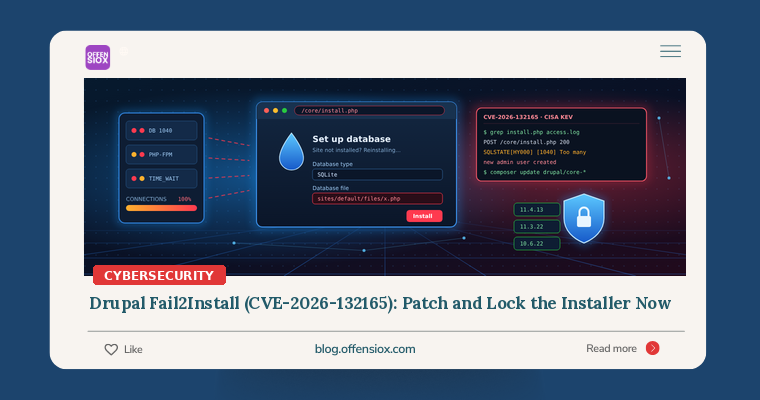
Every Drupal site ships with an installer: core/install.php, the page that sets up a brand-new site. On most production sites it stays reachable long after launch, because no one sees a reason to remove it. Drupal assumed a site that is already installed would never let it run again.
CVE-2026-132165, nicknamed “Fail2Install”, breaks that assumption. If an attacker overloads the server’s resources at the right moment, Drupal can conclude that a live site is not installed and reopen the installer to anyone. From there, an unauthenticated visitor can take over the site or run code on the server. Drupal fixed it on 18 November 2026. Its security team says the flaw was “exploited on live sites as early as 2026-11-19 19:00 UTC”, about a day later. On 24 November CISA added it to the Known Exploited Vulnerabilities (KEV) catalog and gave US federal agencies until 27 November to fix it.
Drupal is widely used by government agencies, universities, media outlets and large enterprises. If you run it anywhere, this is a patch-today issue.
TL;DR / Key takeaways
- What: Pre-authentication site takeover / remote code execution through Drupal core’s installer (
install.php). Drupal rates it Highly critical, 20/25 (SA-CORE-2026-017); reported CVSS is 9.8.- Status: Exploited in the wild since 19 November; on CISA KEV since 24 November; full technical write-up published by Searchlight Cyber the same day.
- Fix: Upgrade to 10.6.22, 11.3.22 or 11.4.13. Drupal 11.2.x and older, 10.5.x and older, and Drupal 8 and 9 are end-of-life and get no patch.
- Do this even after patching: Block public access to
/core/install.phpat the web server, and makesettings.phpread-only for the web server user.- Hunt: If your site was unpatched with the installer reachable after 18 November, check for installer requests, an altered
settings.php, new admin accounts and unexpected.phpfiles.
Timeline
| Date (2026) | Event |
|---|---|
| 27 Oct | Searchlight Cyber confirms pre-auth RCE on stock Apache + PostgreSQL. Its report turns out to duplicate an earlier one from Anthropic’s OSS Scanner (ANT-2026-GMRPK0BU), which Drupal credits. |
| 18 Nov | Drupal publishes SA-CORE-2026-017 and releases 10.6.22, 11.3.22 and 11.4.13. The same releases fix a related gadget-chain issue, CVE-2026-132166 (SA-CORE-2026-018). Initial rating: 18/25. |
| 19 Nov, 19:00 UTC | Earliest exploitation on live sites, according to the Drupal Security Team. |
| 24 Nov | CISA adds CVE-2026-132165 to KEV (with an Idunno AntiCsrf and an Optimizely flaw). Searchlight Cyber publishes its research. Drupal’s rating is now 20/25. |
| 27 Nov | CISA remediation deadline for US federal civilian agencies. |
Drupal has not said who is behind the attacks or how many sites have been hit. The Hacker News notes this is the third Drupal flaw exploited in 2026, after CVE-2026-9082 and CVE-2026-118539.
How Fail2Install works (conceptually)
Searchlight Cyber researchers Kevin Gervot and Adam Kues frame the bug as a fail-open problem. Before running, the installer checks whether Drupal is already installed. Those checks depend on connecting to the database. In the vulnerable code, a failed connection was not treated as an error that should stop the process. Drupal treated it as evidence that the site did not exist yet.
So an attacker’s job is to make those checks fail. The research describes three ways to exhaust ordinary system limits:
- Database connection exhaustion. Flood the site until the database hits
max_connections. Searchlight summarises the race: “if the first and second database connections fail, but the third succeeds, the installation begins.” - TCP source-port exhaustion. Useful on PHP-FPM, whose small default worker count makes connection flooding impractical. Ports pile up in
TIME_WAITuntil new connections fail with “Cannot assign requested address”. - File-descriptor exhaustion (EMFILE). Hit the per-process open-file limit.
Once the installer is running against a live site, the code-execution step abuses a second design weakness. The installer accepted an SQLite database path anywhere, with any extension. A path ending in .php under the document root, combined with a site name containing PHP code, leaves a PHP file on disk. Stock Apache’s Drupal .htaccess would normally block requests to that file. Searchlight found that a rule allowing certain core PHP files was not anchored to the start of the path, so a crafted URL slips past it. We are deliberately not reproducing the exact paths here.
A few practical points from the research and advisory:
- Searchlight demonstrated it on Drupal 8.9, 9, 10 and 11, across Apache or PHP-FPM with MySQL or PostgreSQL. Apache + PostgreSQL was the most reliable default setup.
- Drupal 7 and Drupal 8 before 8.9 are not affected. They refuse to reinstall when
settings.phpalready contains database settings. - Resources matter. Searchlight says PHP-FPM + MySQL was viable on a 4 vCPU server; on 2 vCPU it depends more on configuration. Multiple PHP-FPM replicas behind a load balancer, or a low
tcp_max_tw_buckets, made it harder. - The installer does not need to be internet-facing to be a risk. Anyone who can reach
install.php, including from an internal network or a staging environment, can try.
Drupal originally called exploitation complex and limited to uncommon configurations. Treat that as outdated: public research shows stock stacks are exploitable, and attackers are already doing it.
Am I affected?
You are vulnerable if all of these apply:
- You run Drupal 8.9 through 11, and
- Your core version is below 10.6.22, 11.0.0–11.3.21, or 11.4.0–11.4.12, and
/core/install.phpis reachable (Drupal’s default.htaccessdoes not block it).
| Branch | Status | Action |
|---|---|---|
| 11.4.x | Supported | Update to 11.4.13 |
| 11.3.x | Supported | Update to 11.3.22 |
| 11.0–11.2.x | End-of-life | Block installer now, move to 11.3/11.4 |
| 10.6.x | Supported | Update to 10.6.22 |
| 10.5.x and older, 8.9, 9 | End-of-life | Block installer now, plan migration |
| 7, 8 < 8.9 | Not affected by this bug | Still block the installer; Drupal 7 is EOL |
Check your version quickly:
~|#| From the project root
drush status ~|-|~|-|field~|=|drupal~|-|version
~|#| or, without Drush
composer show drupal/core | grep ~|-|i versions

~|#| Is the installer reachable? Expect 403 or 404. A 200 means exposed.
curl ~|-|s ~|-|o /dev/null ~|-|w "%{http_code}\n" https://example.com/core/install.php
curl ~|-|s ~|-|o /dev/null ~|-|w "%{http_code}\n" https://example.com/core/install.php/foo
Some managed hosts already block the installer, and Drupal Steward (Drupal’s WAF service) customers are protected from known attack vectors. Drupal still says to upgrade.
Mitigation: patch, then lock the installer
1. Upgrade core
composer update "drupal/core~|-|*" ~|-|~|-|with~|-|all~|-|dependencies
drush updatedb ~|-|y
drush cache:rebuild
drush status ~|-|~|-|field~|=|drupal~|-|version   ~|#| confirm 10.6.22 / 11.3.22 / 11.4.13
2. Block install.php at the web server (even after patching)
These snippets follow Drupal’s Securing the installer guide. Server-level rules survive core updates; .htaccess edits get overwritten by Composer scaffolding unless you append them via composer.json.
Apache (virtual host config, both HTTP and HTTPS):
~|<|Location "/core/install.php">
  Require all denied
~|<|/Location>
Apache .htaccess (shared hosting), in the web root:
~|<|Files "install.php">
  Require all denied
~|<|/Files>
Nginx (inside the HTTPS server block):
location ^~ /core/install.php {
  return 404;
}
Watch out for two easy mistakes. First, on Nginx, don’t use the exact-match form location = /core/install.php. Some configurations pass .php/ URLs to PHP, so /core/install.php/foo would still reach the installer. Second, don’t block update.php with an over-broad rule, because you still need it (or drush updatedb). Adjust the paths for subdirectory installs. Run apachectl configtest or nginx -t before reloading, then repeat the curl checks above.
3. Make settings.php read-only
Drupal says some (but not all) exploit paths are mitigated if the web server cannot write to or change permissions on settings.php:
~|#| Owner should be a deploy user, not www~|-|data/apache/nginx
chown deploy:www~|-|data web/sites/default web/sites/default/settings.php
chmod 555 web/sites/default
chmod 444 web/sites/default/settings.php
4. Patch PHP too
The University of Toronto’s advisory also recommends updating PHP: a separate PHP release fixes session flaws whose demonstrated exploits use Guzzle, which Drupal core ships. That matters because the companion CVE-2026-132166 is a gadget chain that turns a separate deserialization flaw into code execution.
Detection and hunting
Drupal has not published IOCs. The signals below come from the vulnerability’s mechanics and from the University of Toronto and Searchlight guidance. Check from 18 November onward at minimum.
Web logs: any installer activity after go-live
~|#| Any hit on the installer, with status code and source IP
zgrep ~|-|hE '"(GET|POST) [^"]*install\.php' /var/log/nginx/access.log* /var/log/apache2/access.log* \
  | awk '{print $1, $4, $6, $7, $9}' | sort | uniq ~|-|c | sort ~|-|rn | head ~|-|50
Splunk equivalent:
index~|=|web (uri_path~|=|"*install.php*")
| stats count min(_time) as first max(_time) as last values(status) as status values(http_method) as methods by src_ip, uri_path
| convert ctime(first) ctime(last)
| sort ~|-| count
A legitimate production site should show essentially no installer traffic. POST requests and 200 responses are high-priority. Pay particular attention to installer requests that arrive alongside a burst of traffic from the same source, which matches the exhaustion technique.
Database and system errors
Searchlight highlights observable side effects of the attack. Look for:
- MySQL/MariaDB “Too many connections” (SQLSTATE 1040) or PostgreSQL “too many clients” errors in Drupal’s watchdog, PHP-FPM or database logs;
- “Cannot assign requested address” (SQLSTATE 2002) errors from PHP;
- Unusual growth in
TIME_WAITsockets between PHP and the database (ss -tan state time-wait | wc -l).
These alone aren’t proof of compromise; busy sites hit limits too. Correlate their timestamps with installer requests.
File system: PHP files that are really databases
The exploit leaves a SQLite database with a .php extension. Every SQLite file starts with the header SQLite format 3, so this check is a strong indicator:
~|#| PHP files whose first bytes are a SQLite header
find /var/www ~|-|type f ~|-|name '*.php' ~|-|size +1k ~|-|exec sh ~|-|c \
  'head ~|-|c 15 "$1" | grep ~|-|q "SQLite format 3" && echo "SUSPICIOUS: $1"' _ {} \;

~|#| PHP files created or changed since the advisory
find /var/www ~|-|type f ~|-|name '*.php' ~|-|newermt '2026~|-|11~|-|18' ~|-|not ~|-|path '*/vendor/*' ~|-|ls

~|#| Any PHP under the public files directory is suspect
find /var/www ~|-|path '*/sites/*/files/*' ~|-|name '*.php*' ~|-|ls

~|#| When was settings.php last modified?
stat ~|-|c '%y %n' /var/www/*/web/sites/*/settings.php
Note that a legitimate core upgrade will also touch many .php files, so focus on locations outside core/, vendor/ and your own modules and themes.
Application and host
- Database connection details in
settings.phpthat you don’t recognise, especially a SQLite driver. - New administrator accounts or role changes:
drush sql:query "SELECT u.uid, u.name, u.created FROM users_field_data u JOIN user__roles r ON u.uid=r.entity_id WHERE r.roles_target_id='administrator' ORDER BY u.created DESC;" - Unexpected modules, cron jobs or system users.
- Web server processes (
php-fpm,apache2,httpd,nginx) spawning shells,curl,wgetor interpreters. In EDR or auditd, alert on parentphp-fpm*/apache2with childsh,bash,curl,wget,python*orperl.
If you find signs of compromise
Isolate the server and preserve evidence before patching or rebuilding: web and PHP logs, the database, and the current settings.php. CISA has told US federal agencies to check for compromise before applying the fix. Hunt for web shells and persistence. Then rebuild from known-good code, restore content from a backup taken before the earliest suspicious activity, and rotate every secret the site held: database passwords, API keys, SMTP credentials, payment gateway keys and the hash_salt. Force a password reset for privileged users.
Prioritised action checklist
Immediately (today)
- Inventory every Drupal instance, including staging, dev, microsites and forgotten department or campaign sites.
- Block
/core/install.phpon all of them and verify withcurl(403/404). - Upgrade supported branches to 10.6.22 / 11.3.22 / 11.4.13.
- Run the log and file-system hunts above for activity since 18 November.
This week
- Make
settings.phpandsites/defaultread-only to the web server user. - Update PHP to the latest patch release for your branch.
- Put end-of-life sites (Drupal 8, 9, 10.5 and older, 11.0–11.2) behind IP allow-lists or a WAF and schedule migrations.
- Add a monitoring rule that alerts on any request to
install.phpin production.
Longer term
- Remove installer scripts from production builds (Drupal’s guide shows a Composer
post-install-cmdapproach). - Deploy code as a non-web-server user, with a read-only code base and a
noexecor PHP-disabled public files directory. - Track the KEV catalog and Drupal security advisories in your patching SLA. For internet-facing CMS platforms, “within days” is now too slow.
OffensioX perspective
Fail2Install is a lesson in failing open. Running out of database connections or ports has always been treated as an availability problem: the site gets slow, someone restarts a service. Here, a resource failure quietly turned into an authorisation decision. The installer read “I can’t reach the database” as “nobody owns this site yet.” Expect to see this class of bug more often. Researchers are now hunting for every place where an application swallows an error and falls back to a permissive default, and both the original reporter and the independent rediscovery here came from automated and AI-assisted analysis. The window between patch and exploitation is shrinking accordingly: here it was about a day. In Pakistan and across the region, CMS platforms behind public-sector, university and media sites are often not on a tight patch cycle, and end-of-life branches linger for years. For those sites, blocking the installer is the one control you can put in place in the next ten minutes, and it should stay in place permanently.
If you’d like help confirming your Drupal estate is patched, hardened and free of signs of compromise, OffensioX offers web application penetration testing and security assessments for CMS platforms.
References
- Drupal Security Advisory SA-CORE-2026-017: Drupal core, Highly critical, Remote code execution
- Drupal.org: Securing the installer (install.php)
- CISA: CISA Adds Three Known Exploited Vulnerabilities to Catalog (24 Nov 2026)
- Searchlight Cyber: Fail2Install, system limits to pre-auth RCE in Drupal
- The Hacker News: Drupal Fail2Install Exploit Details Emerge as Critical RCE Flaw Faces Active Exploitation
- Help Net Security: Critical Drupal installer flaw under active attack (CVE-2026-132165)
- University of Toronto Information Security: Critical remote code execution in the Drupal core installer
- BreachNews: Hackers Exploit Critical Drupal Fail2Install Flaw as CISA Sets 3-Day Deadline
- Horizon3.ai: CVE-2026-132165 Drupal Core Installer RCE