13 min to read
N-central 4EverAble2Shell: The Zero-Day That Beat the Hotfix
A public exploit chain hit patched N-able N-central servers within hours. If you or your MSP run N-central on-premises, here is what to check today.
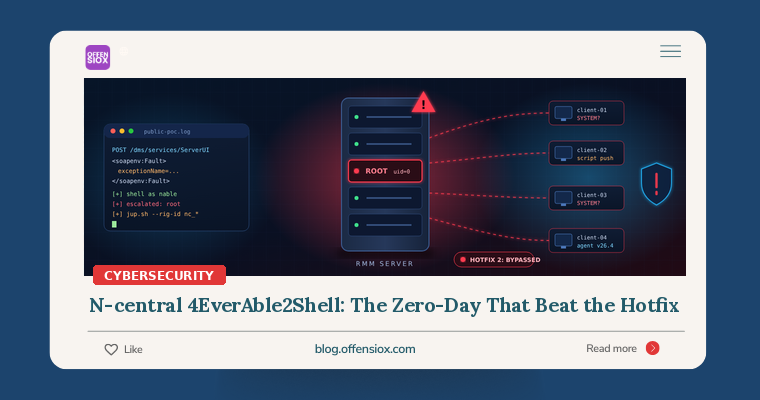
A remote monitoring and management (RMM) server is the most powerful machine most small and mid-sized businesses never think about. It pushes scripts, installs software and opens remote sessions on every laptop and server it manages, usually as SYSTEM or root. Whoever controls it controls the fleet, and if it belongs to your managed service provider (MSP), it controls the fleets of dozens of other companies too.
That is why this week’s events around N-able N-central matter well beyond N-able’s own customers. In six days, a single researcher publicly dropped more than 30 unpatched N-central flaws, N-able pulled its hosted service offline and shipped an emergency hotfix, and then a new chain called 4EverAble2Shell appeared that works against the patched build. Attackers were using it within about five hours. By the afternoon of 12 November, a cryptomining pool listed 21 compromised N-central servers, and 19 of them were already running N-able’s latest hotfix.
As of 15 November there is still no fixed build for 4EverAble2Shell. The good news: it depends on one non-default setting you can turn off today.
TL;DR / Key takeaways
- What: 4EverAble2Shell chains CVE-2026-90436 (CVSS 9.8, a flaw in the bundled, end-of-life Apache Axis 1.x SOAP engine) with an N-central local privilege escalation that has no CVE yet. The result is unauthenticated remote code execution as root on the N-central server.
- Who: On-premises N-central servers with the Legacy API enabled and reachable from the internet. Confirmed working on 2026.4 Hotfix 2 (build 2026.4.1.26) and on 2025.3.1.9. N-able says hosted N-central is not affected.
- Status: Exploited in the wild since 12 November (XMRig cryptominer seen so far). No fixed build yet; N-able has promised a follow-up hotfix.
- Do now: Disable the Legacy API, keep Hotfix 2 installed, upgrade Agents and Probes, and get the server’s web and SOAP endpoints off the open internet.
- Then hunt: Check for the published indicators below. Any hit means an attacker had root on a box that controls your endpoints: treat it as a full compromise, not a miner cleanup.
Timeline
All dates are 2026. Details are still moving, so check N-able’s status page for anything newer.
- 6 November: CVE-2026-90436 in Apache Axis 1.x is disclosed and patches are released, according to Previdian founder Ryan Dewhurst as quoted by The Hacker News.
- 9 November (~04:14 UTC): Researcher Sean Bales publishes proof-of-concept code for Able2Shell, 33 N-central vulnerabilities that chain into four exploit paths (three remote code execution, one root escalation), without prior notice to the vendor. N-able takes hosted N-central offline in the Americas, Europe and Asia-Pacific and tells on-premises customers to shut their servers down. Censys counts 1,728 internet-reachable N-central hosts.
- 10 November: N-able releases N-central 2026.4 Hotfix 2 (build 2026.4.1.26), fixing seven CVEs, and brings hosted servers back online.
- 11 November (late) to 12 November (03:58 UTC): Bales publishes two new exploit sets, 4EverAble2Shell (server root) and Agent2Shell (more than ten flaws leading to SYSTEM on managed Windows endpoints).
- 12 November, 06:30 ET: N-able says the server issue “depends on a non-default configuration in which the Legacy API is turned on and exposed to the public internet” and tells customers to disable it.
- 12 November, 08:30 to 12:50 UTC: Huntback decoys see the first probe at 08:30, the first weaponised request at 09:16, and by 12:50 the attacker’s mining pool lists 21
nc_rigs named after N-central servers. - 13 November, 10:25 ET: N-able publishes indicators of compromise for customers who had not disabled the Legacy API, and turns off the Intune integration as a precaution.
- 14 to 15 November: No fixed build yet. N-able says a further hotfix will follow but has given no date.
How the attack works (conceptually)
4EverAble2Shell is a two-stage chain. You do not need exploit-level detail to defend against it, but you do need to understand why patching to Hotfix 2 was not enough.
Stage 1: an old SOAP engine that loads whatever class you name
N-central bundles Apache Axis 1.x, a SOAP web services engine that reached end of life years ago. CVE-2026-90436 (CVSS 9.8) lets a crafted SOAP fault message cause Axis to instantiate an attacker-named Java class. Huntback’s analysis shows the attackers sending a POST to /dms/services/ServerUI with a SOAP fault whose exceptionName field names a Java class that, when instantiated, runs a shell command built from another field. That gives command execution as the low-privileged nable service account. Per SOCRadar, CVE-2026-90436 on its own does not give root.
This path is only reachable when the Legacy API is enabled. N-able notes it is off by default and “not recommended”, and its 2025.4 release notes already warned that re-enabling deprecated APIs “will expose the N-central server to potential malicious exploits”. In practice, plenty of MSPs turned it back on to keep older scripts and integrations working.
Stage 2: a helper script that trusts a symlink
The second stage abuses an N-central helper script (nable_wrapper.pl) that runs with root privileges. By planting a symbolic link at /var/opt/n-central/flag/flag_default.json, the attacker tricks the root-run helper into rewriting and executing a script of their choosing, then restores the original file to hide the change. This local privilege escalation has no CVE and no fix yet, which is why Hotfix 2 servers fell.
What the attackers did with root
So far the only observed payload is a Monero miner. After escalating, the attackers downloaded a script named jup.sh from 157.20.241[.]16, installed XMRig under a hidden .xvd folder, capped it at half the CPU cores so it would go unnoticed, and added systemd and cron persistence with a watchdog. Each miner was labelled with the victim’s IP address.
Do not be reassured by the “only a miner” headline. As Huntback put it: “Treat a hit as a full compromise, not a cleanup job.” The same wallet also ran hundreds of miners on other exploited platforms such as Jpom, FreePBX, MLflow and PaperCut, which tells you this is an opportunistic crew spraying fresh exploits. The next group to use the public PoC may want your customers’ endpoints, not your CPU.
Agent2Shell: the endpoint side
The companion set, Agent2Shell, targets how N-central talks to Windows Agents and Probes. Huntress’s review describes two chains that could let an unauthenticated attacker run commands on managed Windows endpoints as SYSTEM, and The Hacker News reports it needs the target appliance ID. N-able has confirmed Agent2Shell also requires the Legacy API. No in-the-wild exploitation of Agent2Shell had been reported at the time of writing.
Am I affected?
| Situation | Exposed to 4EverAble2Shell? |
|---|---|
| On-premises N-central, Legacy API enabled and internet-reachable | Yes, including on Hotfix 2 (2026.4.1.26) |
| On-premises N-central, Legacy API enabled but only reachable internally | Reduced, but any foothold on an allowed network can reach it |
| On-premises N-central, Legacy API disabled, on Hotfix 2 | Not exposed to this chain, per N-able and Huntress |
| Hosted N-central (N-able cloud) | Not affected, per N-able; you still need to upgrade Agents and Probes |
| Your business is managed by an MSP that uses N-central | Possibly, through your MSP. Ask them (questions below) |
N-able has not published a full list of affected versions. Confirmed vulnerable builds are 2026.4.1.26 and 2025.3.1.9. N-able has also warned that live hotfixes do not always change the version number, so confirm your build against its upgrade guidance rather than the “About” screen alone.
If you are an MSP’s customer
Many businesses in Pakistan, the Gulf and elsewhere do not run N-central themselves but have its agent on every PC. Send your MSP these four questions today:
- Do you use N-central, and is it hosted or on-premises?
- If on-premises, is the Legacy API disabled, and since when?
- Have you checked your server against N-able’s and Huntback’s indicators of compromise?
- Have you upgraded the Agents and Probes in our environment to the Hotfix 2 versions?
Detection: did someone already get in?
Hunt on every on-premises N-central server, especially any where the Legacy API was ever enabled. The indicators below were published by Huntback and N-able. A clean result does not prove the server is clean: N-able says it has identified additional indicators, and the original Able2Shell PoC was reported to clean up its own staging logs.
Network and web indicators
- Outbound connections to
157.20.241[.]16(port 8080, and callback ports 19202 to 19418),139.99.69[.]109:10128and79.76.51[.]56:39100. - Requests to
/jup.sh,/xvgz,/xmrig.tgz,/ob/cronhitor/ob/fcheckon157.20.241[.]16:8080. - Inbound
POST /dms/services/ServerUIcontaining a SOAP fault with anexceptionNameelement, especially namingjline.internal.TerminalLineSettings, often with user agentpython-requests/2.31.0.
Host checks (run from the console as root)
~|#| Hidden miner folders and N~|-|central staging leftovers
ls ~|-|la /tmp/.xvd /var/tmp/.xvd 2>/dev/null
ls ~|-|la /var/opt/n~|-|central/tmp/ | grep ~|-|i serverchild
~|#| The privilege~|-|escalation symlink
find /var/opt/n~|-|central/flag ~|-|name 'flag_default.json' ~|-|type l ~|-|ls

~|#| Persistence
ls ~|-|la /etc/systemd/system/xvd.service /etc/cron.d/xvd 2>/dev/null
grep ~|-|r "xvkeep" /var/spool/cron/ /etc/crontab /etc/cron.d/ 2>/dev/null

~|#| Miner processes
ps ~|-|eo pid,user,args | grep ~|-|E ~|-|~|-| '~|-|~|-|rig~|-|id nc_|~|-|~|-|donate~|-|level 1|\.xvd/x' | grep ~|-|v grep

~|#| Known escalation script hash (SHA~|-|256)
find / ~|-|xdev ~|-|type f ~|-|newermt '2026~|-|11~|-|08' ~|-|size ~|-|200k ~|-|exec sha256sum {} + 2>/dev/null \
  | grep fc4c01fd11bc301cf312830460cfdccc3af9dcfe50c910b86d6a1117bc76c747
Also review, from 8 November onward: new or changed administrator and technician accounts, new JSP or other files under /opt/nable/webapps, unexpected program( entries in syslog-ng configuration, new scripts and automation policies, and remote-control sessions nobody can explain. These come from the Cloud Security Alliance and Huntress guidance for the earlier Able2Shell chains, which share the same attack surface.
SIEM query ideas
If your firewall or proxy logs go to a SIEM, a simple outbound-IOC sweep is quick to run. Adjust field names to your schema.
~|#| Splunk SPL
index~|=|network (dest_ip~|=|"157.20.241.16" OR dest_ip~|=|"139.99.69.109" OR dest_ip~|=|"79.76.51.56")
| stats count min(_time) as first_seen max(_time) as last_seen by src_ip dest_ip dest_port
// Microsoft Sentinel / Defender (KQL)
let iocs ~|=| dynamic(["157.20.241.16","139.99.69.109","79.76.51.56"]);
CommonSecurityLog
| where TimeGenerated > datetime(2026~|-|11~|-|08)
| where DestinationIP in (iocs) or SourceIP in (iocs)
| summarize count(), min(TimeGenerated), max(TimeGenerated) by SourceIP, DestinationIP, DestinationPort
For web logs in front of N-central, alert on any POST to /dms/services/ServerUI whose body contains soapenv:Fault or exceptionName from a source that is not one of your known integrations.
On managed Windows endpoints
SOCRadar suggests reviewing changes since 11 November: SYSTEM-level encoded PowerShell launched by the N-able agent that does not match your known scripts, unexpected changes to Windows Software Probe binaries or its service, new local administrator accounts, and newly installed remote-access tools. Encoded PowerShell from an RMM agent is normal, so compare against your script library rather than alerting on every instance.
What to do: a prioritised checklist
Immediately (today)
- Disable the Legacy API on every on-premises N-central server using N-able’s knowledge base article “How to Disable Legacy API settings on On-Premises N-central servers”, and confirm the setting saved. Note which integrations break; that list is your tech debt.
- If you cannot disable it right now, take the server off the internet. Put the web and SOAP endpoints behind a VPN or management network. Do not rely on IP allowlisting alone.
- Stay on Hotfix 2 (2026.4.1.26) and upgrade Agents first, then Probes, as N-able instructs. Hotfix 2 does not stop 4EverAble2Shell, but it fixes the seven earlier Able2Shell CVEs.
- Run the IOC hunt above. If anything matches, isolate the host, preserve logs and a disk image, and call your incident response provider.
This week
- If compromised, rebuild, do not clean. Reinstall from known-good media, then rotate every credential N-central stores or uses: domain admin, hypervisor, backup, cloud and identity-provider accounts, plus API keys for integrations.
- Audit what the server did since 8 November: scripts pushed, remote sessions, new accounts, policy changes. Assume any customer it manages may need its own review.
- Keep the Intune integration off until N-able restores it, and watch N-able’s status page for the follow-up hotfix. Apply it as soon as it ships.
- Tell your customers (if you are an MSP) what you checked and what you found. Silence now costs more trust later.
Longer term
- Never expose RMM consoles to the internet. Require VPN or zero-trust access with phishing-resistant MFA for technicians.
- Kill legacy interfaces. If an old script needs a deprecated API, rewrite the script. Old SOAP engines like Axis 1.x are a recurring source of critical bugs.
- Monitor the RMM itself: forward its logs to your SIEM and alert on new admins, new scripts and off-hours mass deployments.
- Plan for RMM loss. This week, hosted customers lost N-central for about a day. Keep an out-of-band way to reach and patch critical systems.
OffensioX perspective
Three trends collide in this story. First, RMM is supply chain. Attackers keep going after RMM platforms because one compromised server leads to many victims, and an MSP’s N-central server can reach every client it manages. Second, the patch-to-exploit window is now hours, not weeks. Here the exploit was public before the fix, the attackers moved in about five hours, and the vendor’s own hotfix did not cover the new chain. Bales also says the research was AI-assisted, a reminder that bug discovery is getting faster and cheaper on both sides. Third, legacy compatibility settings are attack surface. The single control that blocks this chain was a default-off switch that many teams had turned back on for convenience. The lesson is not specific to N-able: every “temporarily re-enable” toggle in your security tools deserves an owner and an expiry date.
If you want an independent view of how exposed your RMM, remote-access and management stack really is, OffensioX offers penetration testing and security assessments covering MSP tooling and internet-facing infrastructure.
References
- SecurityWeek: Hackers exploit new N-central zero-day hours after PoC publication
- The Hacker News: New N-central exploits work against patched servers, enable root RCE and Windows SYSTEM access
- Huntback: 4EverAble2Shell is already mining Monero on live N-central servers
- Huntress: N-able disables cloud services following disclosure of Able2Shell exploit chains
- SOCRadar: 4EverAble2Shell, N-central zero-day exploited
- Cloud Security Alliance: Able2Shell, N-central zero-days and the RMM kill switch
- Tuskira: N-able N-central Able2Shell advisory tracker
- BleepingComputer: New N-able 4EverAble2Shell zero-day exploited hours after PoC released
- N-able: N-central 2026.4 HF2 release notes
- N-able: N-central 2025.4 release notes (deprecated API warning)
- N-able status: incident 202613
- NVD: CVE-2026-90436