13 min to read
vCenter Zero-Day CVE-2026-123890: What Happened and What to Do
A China-linked group chained two zero-days to reach vCenter, forge SAML tokens and copy Active Directory off ESXi disks. Patch it as an emergency change, then hunt.
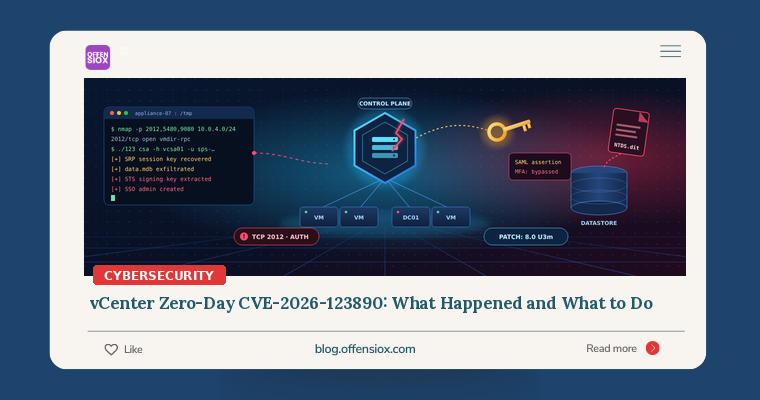
For a suspected Chinese espionage group, a vCenter server is the ideal target. Whoever controls it controls every virtual machine, every datastore and, in most organisations, a quiet copy of the domain controllers’ disks. On 19 November 2026 Broadcom patched CVE-2026-123890, a critical authentication bypass in VMware vCenter. The same day, Google Threat Intelligence Group (GTIG) and Mandiant revealed that a group they call Armory Castle had already been using it since early September.
The intrusion GTIG describes is a lesson in how modern data-centre compromises work. Attackers got in through a zero-day in a remote support appliance and moved through Linux boxes that had no EDR. They used the vCenter flaw to make themselves an SSO administrator, forged SAML tokens to get around MFA, and then read Active Directory database files directly off ESXi datastores. Nobody needed to log in to a single Windows server for that.
TL;DR / key takeaways
- What: CVE-2026-123890 (CVSS 3.1 9.8) is an unauthenticated authentication bypass in the VMware Directory Service (
vmdir) of vCenter. It is reachable over DCE/RPC on TCP 2012 and gives the attacker a session as[email protected].- Who exploited it: Armory Castle, a suspected PRC-nexus espionage actor formerly tracked as UNC5221. Mandiant found exploitation from early September 2026, more than two months before the patch.
- Fix: vCenter 8.0 U3m, 9.0.2.0200, 9.1.1.0200, VCF 5.2.5. There is no workaround, and the update cannot be applied with vCenter Quick Patch. Broadcom treats it as an emergency change.
- Not enough to patch: Armory Castle stole SAML signing keys and created backdoor accounts. If your vCenter was reachable from a compromised segment, hunt for compromise and rotate credentials.
- Longer term: treat vCenter as Tier-0. Restrict TCP 2012/443/5480/22 to admin hosts, block appliance egress, and forward appliance logs to your SIEM.
What happened
The flaw
According to GTIG, CVE-2026-123890 is “an unauthenticated Secure Remote Password (SRP-6a) session key disclosure vulnerability over Distributed Computing Environment/Remote Procedure Calls (DCE/RPC).” Put simply, the vmdir service on TCP 2012 has a weakness in how it generates the identifiers it uses during SRP authentication. GTIG traces this to predictable UUIDv1 timestamps. As a result, an attacker can recover the shared session key without knowing any password and use it to act as the built-in SSO administrator.
Broadcom’s advisory, VMSA-2026-0009, rates the vCenter issue Critical. The advisory also fixes four other bugs: SQL injection, command injection and local privilege escalation in SDDC Manager (CVE-2026-123891 to -123893), and a SAML signature bypass in VMware Tools for Windows (CVE-2026-123894). Two points from Broadcom’s FAQ matter for planning:
- Turning off Enhanced Linked Mode does not protect you. The bug is in vCenter itself.
- CVE-2026-123890 is a different bug from CVE-2026-59309, the
vmdirLDAP bypass patched in July (VMSA-2026-0006). A vCenter patched for July’s bug is still vulnerable. In GTIG’s case, the vCenter Armory Castle attacked had already been patched for CVE-2026-59309.
GTIG says Mandiant “has evidence that ARMORY CASTLE had knowledge of CVE-2026-123890 prior to the disclosure of CVE-2026-59309 on July 29, 2026.” The main exploit tool, BONESAW, has an embedded build timestamp of 13 July 2026. GTIG says it was “likely developed for broader operations”, though build metadata can be faked.
The attack chain
GTIG’s write-up follows a single intrusion from start to finish. In summary:
- Initial access came through CVE-2026-102764, a zero-day in BeyondTrust Remote Support that BeyondTrust fixed in BT26-05. GTIG covered that stage on 15 October.
- Recon and pivot: from the Remote Support appliance, the actor ran nmap against internal ranges, looking for VMware ports (443, 2012, 389, 5480, 9080) among others. They then moved to an internal Linux appliance with no EDR.
- Foothold: they dropped two JSP web shells, SLIMSAVAGE (
ActiveSer.jsp) and CAGEMATCH (u.jsp). They used gdb to set the SUID bit on/bin/env, which gave them root. - vCenter takeover: they ran BONESAW (
/tmp/123) against vCenter. It exploits CVE-2026-123890, copies the directory database (/storage/db/vmware-vmdir/data.mdb), extracts the STS SAML signing key and creates a new SSO administrator. - Golden SAML: SAWSNAKE (
/tmp/sss), a Go port of a publicvcenter_saml_login.pytool, used the stolen key to forge SAML assertions and admin session cookies. That lets the attacker impersonate users and skip MFA. - Hands-on in vCenter: they created a local admin following the pattern
sps-<…>@vsphere.localand turned on SSH through the appliance management API (PUT /rest/appliance/access/ssh). Over SSH they took the vCenter master symmetric key and PostgreSQL credentials, then switched SSH off again. - ESXi and data theft: they logged into ESXi as
vpxuser, added an SSH key to root’sauthorized_keysand used avmfs_browser.pytoolkit to pull NTDS.dit, SYSTEM and SECURITY hives and DNS files straight out of guest VMDKs. Files were staged in a hidden/vmfs/volumes/<volume>/.adirectory, archived aso.tar.gzand copied out with SCP. - Persistence: the actor installed BEARBONES (
/tmp/dbr), a backdoored Dropbear SSH server listening on TCP 53 and 33992 that logs plaintext credentials. On another appliance they installed LAZYBONES (/usr/bin/vmtoolscs), a Go backdoor that gets its commands from Slack and runs as a systemd service that restarts every 50 minutes.
GTIG’s summary: the actor “exploited two zero-days, and deployed three sets of malware specifically tailored for operating on targeted devices, indicating deep platform expertise and substantial resource backing.”
Timeline
- 13 Jul 2026: BONESAW build timestamp.
- 29 Jul 2026: Broadcom discloses the separate
vmdirLDAP bug CVE-2026-59309. - Early Sep 2026: Armory Castle exploits CVE-2026-123890 in the wild.
- 15 Oct 2026: GTIG publishes the BeyondTrust Remote Support (CVE-2026-102764) stage.
- 19 Nov 2026: Broadcom publishes VMSA-2026-0009 with fixed builds. GTIG/Mandiant publish the vCenter analysis.
- 20 Nov 2026: Broadcom revises the advisory (VMSA-2026-0009.1).
Still developing: when this post was written, CVE-2026-123890 was not yet in CISA’s KEV catalogue, according to Ostorlab and Rescana. CISA’s Vulnrichment record still listed exploitation as “none”, and there is no public proof-of-concept. Mandiant’s forensic evidence is what matters, and attackers can now diff the patch.
Am I affected?
You are affected if you run any vCenter build older than the fixed versions below. That includes standalone vCenter and vCenter inside VMware Cloud Foundation, vSphere Foundation, Telco Cloud Platform or Telco Cloud Infrastructure. Broadcom’s FAQ says: if in doubt, presume you are affected.
| Product / line | Fixed version |
|---|---|
| VCF / vSphere Foundation 9.1.x | 9.1.1.0200 |
| VCF / vSphere Foundation 9.0.x | 9.0.2.0200 |
| vCenter 8.0 | 8.0 U3m |
| VCF 5.x | vCenter 8.0 U3m + SDDC Manager 5.2.5 |
| vCenter 7.0 | No public build; extended-support customers must contact Broadcom |
| vSphere 6.5 / 6.7 | Presume affected (end of life) |
| Telco Cloud Platform / Infrastructure | vCenter 8.0 U3m (KB463116) |
ESX itself is not affected by CVE-2026-123890, but in this campaign ESXi was where the data was stolen. If you run VMware Tools for Windows 11.x to 13.x, also update to 13.1.5.0 or 12.5.5 for CVE-2026-123894.
Your risk is highest if:
- TCP 2012, 443 or 5480 on vCenter is reachable from user networks, other appliances or remote support/VPN segments, not just from a few admin hosts;
- you run BeyondTrust Remote Support, or any other edge appliance, that had not received BT26-05 or similar emergency patches before mid-October;
- your vCenter, ESXi hosts and Linux-based appliances have no EDR and do not send logs to a SIEM.
Many organisations in Pakistan and the wider region still run vSphere 6.7 or 7.0 on-premises because of licensing changes since Broadcom’s acquisition. Those versions are end of life, and for 7.0 a fix is only available through extended support. If that describes you, isolating vCenter’s network access is no longer optional. It is your main control until you migrate.
How to detect it
GTIG published file names, behaviours, YARA rule names and a set of suspected obfuscation-network IPs. It did not publish file hashes, which are held in a GTI collection for registered users. Use the following as hunting leads and verify anything you find.
On the vCenter appliance and other Linux appliances (run as root, from a trusted session):
~|#| Known tool/backdoor paths from GTIG
ls ~|-|la /tmp/123 /tmp/sss /tmp/dbr /tmp/123.key /usr/bin/vmtoolscs 2>/dev/null
ls ~|-|la /tmp/rsa_host_key /tmp/ecdsa_host_key /tmp/dss_host_key 2>/dev/null

~|#| SUID bit set on env (the gdb privilege~|-|escalation trick)
ls ~|-|l /bin/env /usr/bin/env

~|#| BEARBONES listeners (TCP 33992, or an unexpected listener on 53)
ss ~|-|tlnp | grep ~|-|E ':(33992|53)\b'

~|#| JSP web shells on appliances with a Java web tier
find / ~|-|xdev \( ~|-|name 'ActiveSer.jsp' ~|-|o ~|-|name 'u.jsp' \) 2>/dev/null

~|#| LAZYBONES~|-|style persistence
grep ~|-|rl 'vmtoolscs' /etc/systemd /usr/lib/systemd 2>/dev/null
In vCenter SSO: list all users in the vsphere.local domain and look for accounts you did not create, especially ones matching sps-*. You can do this in the vSphere Client (Administration → Single Sign On → Users and Groups) or with the community VMware.vSphere.SsoAdmin PowerCLI module. Also check the members of the Administrators group and any new global permissions on the root folder. BONESAW assigns Global Administrator through the vSphere SOAP API.
On ESXi hosts:
~|#| Unexpected root SSH keys
cat /etc/ssh/keys~|-|root/authorized_keys

~|#| Hidden staging directories on datastores
find /vmfs/volumes/ ~|-|maxdepth 2 ~|-|type d ~|-|name '.a' 2>/dev/null
In your SIEM, if vCenter logs reach it (Splunk example; adjust index and field names):
index~|=|vmware sourcetype~|=|*vcenter* "PUT" "/rest/appliance/access/ssh"
| stats count min(_time) as first max(_time) as last by host, src, user
Other things to alert on:
- connections to vCenter TCP 2012 from anything other than other vCenter/PSC nodes;
- outbound HTTPS from vCenter or Linux appliances to Slack (
slack.comAPIs); - the SSH banner
SSH-2.0-pulsesecure_23345on any internal or internet-facing host; - nmap-style sweeps of 443/2012/389/5480/9080 from an appliance;
- connections to or from the IPs GTIG lists (see the GTIG post; treat them as obfuscation infrastructure, not definitive attribution).
Google SecOps customers get curated rules such as “VMware vCenter VAMI API SSH Enablement”. If you use another stack, rebuild the equivalent logic from the GTIG YARA rules (G_Hunting_Utility_BONESAW_2, G_Hunting_Backdoor_BEARBONES_1, G_Hunting_Backdoor_LAZYBONES_1 and others).
What to do: prioritised checklist
Immediately (today)
- Patch vCenter to 8.0 U3m, 9.0.2.0200 or 9.1.1.0200 (VCF 5.x: 5.2.5). Quick Patch will not work, so plan a full update. The management interfaces go offline during the update, but running workloads keep going.
- Check your upgrade path. Broadcom notes that 8.0 U3m and 9.0.2.0200 block upgrades to VCF 9.1.1. If you are partway through a 9.1 migration, read the FAQ before you start.
- Restrict network access to vCenter while you schedule the patch: allow TCP 443, 2012, 5480 and 22 only from named admin jump hosts and from other vCenter nodes.
- Patch your edge, especially BeyondTrust Remote Support / Privileged Remote Access (BT26-05) and any other remote-access appliance.
This week
- Hunt using the checks above across vCenter, ESXi and every Linux-based appliance in the management network.
- If you find anything, or cannot rule it out: treat it as an identity compromise. Rebuild or restore vCenter from a known-good state. Replace the STS signing certificate (otherwise the forged SAML tokens keep working). Reset
[email protected]and service-account passwords, remove unknown SSH keys, and assume domain controller hashes were stolen, which means a double krbtgt reset and privileged password rotation in Active Directory. - Update VMware Tools for Windows and SDDC Manager as part of the same advisory.
Longer term
- Make vCenter Tier-0. Use dedicated admin workstations, avoid SSO trust to general-purpose AD accounts where you can, and keep a separate management network.
- Control egress. vCenter and ESXi rarely need to reach the internet. Blocking outbound traffic would have stopped both the SCP exfiltration and Slack C2 in this case. Mandiant’s VCSA hardening tool uses iptables to enforce inbound and outbound DROP policies independently of VAMI. Test it under change control first.
- Turn appliances into sensors. Forward vCenter, ESXi and appliance syslog, including shell activity, to your SIEM. Mandiant’s vSphere defender’s guide is a good blueprint.
- Plan off end-of-life vSphere. 6.5, 6.7 and 7.0 will keep collecting bugs like this.
OffensioX perspective
This campaign confirms a pattern we have written about all autumn: serious attackers have stopped going through the endpoint. Edge appliances (BeyondTrust, Ivanti, SonicWall, Check Point) give them the way in. Unmonitored Linux appliances let them move. Hypervisor management planes give them everything else, and none of these run EDR. What is new here is the spending: two zero-days and three custom malware families used in one intrusion, to reach a vCenter that had already been patched for the previous bug. “We applied July’s patch” is not a security posture.
The most important lesson is architectural. The attack needed TCP 2012 on vCenter to be reachable from an appliance in another part of the network. In most environments we test, the management plane is reachable from far more places than anyone realises, and from the hypervisor, an AD database is just another file on a datastore. Patching closes this CVE. Segmentation, egress control and logging would have made this whole class of attack visible.
OffensioX runs internal penetration tests and infrastructure assessments that specifically test how far an attacker can get from a compromised edge device toward vCenter and ESXi. If you are not sure what can reach your management plane, we can help you find out.
References
- Google Threat Intelligence Group / Mandiant: ARMORY CASTLE Exploits vSphere
- Broadcom: VMSA-2026-0009 security advisory
- VMware: VMSA-2026-0009 Questions & Answers (GitHub)
- Rapid7: CVE-2026-123890, Critical Authentication Bypass in VMware vCenter
- The Hacker News: China-Linked Hackers Exploit Critical VMware vCenter Zero-Day
- Ostorlab: VMware vCenter Auth Bypass Exploited in the Wild (CVE-2026-123890)
- Mandiant: vSphere and BRICKSTORM Malware, A Defender’s Guide
- Mandiant: VCSA Hardening & Logging Tool