13 min to read
The Ghost in Your Wiki: What the Confluence Axis Attacks Mean for Business
A long-retired library nobody remembered turned company wikis into a skeleton key. Here is what owners and managers should do this week.
Ask most companies what their most sensitive system is and they will name the bank portal, the ERP or the customer database. Very few will say “the wiki”. Yet this week, the internal wiki is exactly where attackers went shopping.
On 13 November 2026, Rapid7’s managed detection team caught an intruder inside a customer’s Atlassian Confluence Data Center server. The way in was CVE-2026-90436, a critical flaw not in Confluence’s own code but in Apache Axis 1.x, a SOAP web-services library that reached end of life many years ago and that Confluence still carried for its legacy remote API. Within minutes the attacker was reading the wiki’s database. Within twelve hours they were signed in to the victim’s Microsoft 365 tenant. On 18 November, CISA added the flaw to its Known Exploited Vulnerabilities (KEV) catalog and gave US federal agencies until 21 November to deal with it.
This post explains, in plain language, what happened, why an old library is a business problem rather than just an IT one, and what to do in a prioritised order.
TL;DR / Key takeaways
- It is being exploited now. CVE-2026-90436 (CVSS 9.8 per CISA; 9.3 under Atlassian’s CVSS 4.0 rating) allows unauthenticated remote code execution. Confirmed victims include Confluence Data Center and N-able N-central servers.
- Only one setting decides exposure. Confluence Data Center 1.x to 9.x is vulnerable when “Remote API (XML-RPC & SOAP)” is turned on. Fixed in 9.2.28; Confluence 10.x removed the feature; Atlassian Cloud is not affected.
- The wiki was the treasure map. The attacker searched pages and attachments for passwords, tokens, VPN configs, private keys and card numbers, then used a stolen service account to reach a cloud data warehouse and Microsoft 365.
- Old code hides inside products you trust. Apache will not ship a fixed Axis 1.x. Other software that bundles it may be exposed too, and most inventories would not show it.
- What to do: Patch or switch off the Remote API today, check for signs of compromise back to 6 November, and rotate every secret your wiki touched if anything looks wrong.
What happened, in plain language
The flaw: a forgotten engine under the hood
Apache Axis 1.x is a Java library for SOAP, an XML-based way for applications to talk to each other that was popular in the 2000s. Many products embedded it and then moved on to newer interfaces, but kept the old component around so customer integrations would not break.
According to the Apache advisory posted to the oss-security list on 6 November, Axis 1.x mishandles incoming SOAP fault messages (the format used to report errors). When a fault names a Java class, Axis loads that class and runs its constructor before checking that it is a legitimate error type. With the right class available to the application, that becomes remote code execution. Crucially, the advisory notes that faults are parsed before any per-service handlers run, so authentication on the service does not protect you.
Apache marked the issue “UNSUPPORTED WHEN ASSIGNED”: Axis 1.x is end of life, and the project does not plan a fixed 1.x release. It recommends migrating to Axis 2 or another SOAP engine, or applying a published patch commit to your own build. In other words, the fix depends on every vendor that bundled the library.
How it hit Confluence
Confluence uses Axis for its XML-RPC and SOAP APIs, exposed through the “Remote API (XML-RPC & SOAP)” setting. Atlassian’s advisory (9 November) says this setting has been off by default for new installations since Confluence 3.0. But many long-running installations, especially those integrated with older scripts, reporting tools or add-ons, still have it on.
Rapid7 describes the attack chain it saw:
- Unauthenticated POST requests to the SOAP endpoint
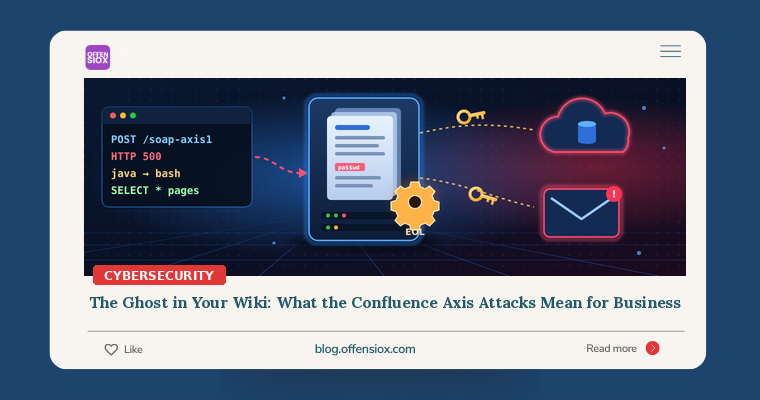
/plugins/servlet/soap-axis1/confluenceservice-v2. Every request returned an HTTP 500 error, yet the Confluence Java process startedbashandcurlunder the Confluence service account within seconds. - Hundreds of hex-encoded commands fetched from temporary Pinggy and Cloudflare Tunnel domains. Rapid7 says the structure of the output suggests AI-assisted automated tooling.
- About three minutes after first execution, the attacker used Confluence’s own database credentials to query page content, application links and attachments, looking for files named after credentials, tokens, VPN configs and private keys. Scripts also parsed Office documents for payment card numbers, using a Luhn check to filter out false positives.
- Attempts against the internal Atlassian Crowd directory API and AS-REP roasting against a domain controller, both of which failed.
- About four hours in, the attacker obtained a service account credential and queried a production cloud data warehouse.
- About twelve hours in, they signed in to Microsoft 365 as an integration service account using legacy authentication.
That last step is the business lesson. The vulnerable server was a wiki, but the damage reached the data warehouse and the email tenant, because the wiki held the keys.
Timeline
| Date (2026) | Event |
|---|---|
| 6 Nov | Apache discloses CVE-2026-90436 in Axis 1.x (end of life, no fixed release planned) |
| 9 Nov | Atlassian publishes its Confluence Data Center advisory; fix listed in 9.2.28 |
| 12 Nov | Public proof-of-concept targeting N-able N-central released |
| 13 Nov | Rapid7 MDR detects exploitation of a Confluence Data Center customer; N-able reports in-the-wild N-central exploitation |
| 16 Nov | Rapid7 publishes its findings; N-able ships N-central 2026.4 HF3, which disables the Legacy API |
| 17 Nov | Rapid7 releases a Metasploit module for Confluence with the Remote API enabled |
| 18 Nov | CISA adds CVE-2026-90436 to the KEV catalog, due date 21 November |
Once a Metasploit module exists, exploitation is no longer limited to skilled operators. Expect broad scanning.
Am I affected?
Confluence
- Atlassian Cloud (
*.atlassian.net): not affected, no action required, per Atlassian. - Confluence Data Center or Server 1.x to 9.x: affected only if the “Remote API (XML-RPC & SOAP)” setting is enabled. Check under the gear icon > General Configuration > Further Configuration.
- Fixed version: 9.2.28 (the fix version listed in Atlassian’s tracker, CONFSERVER-104610). The tracker also lists 9.3.x, 9.4.x and 9.5.x builds as affected without a fix on those lines, so customers on those versions should plan a move to 9.2.28 LTS or 10.x, or switch the Remote API off. Confluence 10.x removed the feature entirely.
- Quick external check: Atlassian says browsing to
<your-base-url>/plugins/servlet/soap-axis1/confluenceservice-v2should return HTTP 403 Forbidden when the mitigation works. Prophet Security cautions that a proxy or WAF can also return 403, so confirm in the admin page too.
N-able N-central
- On-premises and hosted deployments with the non-default Legacy API enabled were exposed. Upgrade to 2026.4 HF3 (2026.4.1.39) and confirm the Legacy API is disabled, following N-able’s instructions.
Anything else built on Java
Field Effect makes the point bluntly: “Most software inventories track products rather than embedded libraries, so organizations may be unaware they run it.” Older in-house Java applications, vendor appliances and middleware can all carry axis.jar or axis-1.4.jar. If your IT team or vendors cannot say whether you run Axis 1.x, that is itself an answer: you do not know.
Why this matters to the business, not just IT
1. Your wiki is a password manager you did not choose. Teams paste database connection strings into runbooks, attach VPN profiles to onboarding pages and leave API keys in “temporary” troubleshooting notes. The attacker in Rapid7’s case went straight for exactly that, and also hunted for card numbers inside attached spreadsheets. For an e-commerce business, a card number in a wiki attachment can turn a wiki breach into a payment-card compliance incident.
2. Integration accounts are the bridge to the cloud. The jump from wiki to data warehouse and Microsoft 365 happened through service and integration accounts. These accounts often have broad permissions, no MFA and old-style (“legacy”) authentication enabled, because “the integration breaks otherwise”.
3. Self-hosting means owning the patch clock. Many organisations, including plenty in Pakistan and the wider region, keep Confluence on-premises for data-residency, cost or connectivity reasons. That is a legitimate choice, but it means nobody patches it for you. CISA gave federal agencies three days. Most private firms take weeks.
4. “End of life” does not mean “gone”. Apache stopped maintaining Axis 1.x long ago, yet it was still shipping inside two widely used commercial products in 2026. Every vendor product you run is a bundle of other people’s code, and the oldest parts are often the least watched.
Your prioritised action plan
Immediate (today)
- Find every self-hosted Confluence (production, staging, “old wiki” servers nobody decommissioned) and check whether the Remote API is enabled.
- Patch to 9.2.28 or move to 10.x. If you cannot do it today, untick “Remote API (XML-RPC & SOAP)” and save. Atlassian says no restart is needed, but scripts and add-ons using the API may break, so tell the owners.
- Verify the SOAP endpoint now returns 403, both from outside and from inside your network.
- Take Confluence off the open internet if it does not need to be there. Put it behind VPN or zero-trust access.
- N-central customers: confirm you are on 2026.4 HF3 and the Legacy API is off.
- Ask your key software vendors in writing whether their products include Apache Axis 1.x, and if so, what their fix plan is.
This week
- Look for signs of compromise back to 6 November (Apache’s disclosure date), on every exposed instance and every cluster node. Rapid7 notes that finding none of its indicators does not prove you are clean. The checks below are a starting point.
- Hunt for secrets in Confluence. Search pages and attachments for terms such as
password,token,BEGIN RSA PRIVATE KEY,.ovpnand connection strings. Move what you find into a proper vault and rotate it. - Review integration and service accounts connected to Confluence: application links, Crowd/LDAP bind accounts and Microsoft 365 integration users. Remove what is unused and enforce MFA or conditional access where possible.
- Block legacy authentication in Microsoft Entra ID, which the attacker used for their M365 sign-in.
Longer term
- Build a software bill of materials (SBOM) habit. Ask vendors for SBOMs and scan your own Java estates for end-of-life libraries.
- Treat the wiki as a crown-jewel system in risk registers, monitoring and access reviews.
- Alert on application servers spawning shells. A Java web app running
bash,curl,cmd.exeorpowershell.exeshould page someone. - Set an emergency patch SLA for internet-facing systems on the CISA KEV list (for example, 72 hours), with authority to take systems offline when a fix is not ready.
What your security team should check
These are defensive starting points drawn from the indicators and guidance published by Rapid7, Atlassian, Field Effect and Prophet Security. Adapt field names to your tools.
Web/proxy logs: SOAP requests to the vulnerable endpoint (Linux shell)
~|#| Tomcat access logs on each Confluence node (path varies by install); use reverse~|-|proxy logs if Tomcat only sees the proxy IP
grep ~|-|E 'POST [^ ]*(soap~|-|axis|/rpc/xmlrpc)' /opt/atlassian/confluence/logs/conf_access_log.*.log \
  | awk '$9 ~|=|~|=| 500' | less
Rapid7 reports every malicious POST in its case returned HTTP 500. Legitimate integrations can also produce errors, so investigate source IPs you do not recognise.
EDR/SIEM: Confluence spawning a shell (Splunk-style pseudocode)
index~|=|edr parent_process_name IN ("java","java.exe","tomcat9.exe")
  process_name IN ("sh","bash","curl","wget","cmd.exe","powershell.exe","psql","mysql")
  host IN (~|<|confluence_hosts>)
| stats count min(_time) as first_seen by host, process_name, process_command_line
Baseline first: Synchrony is a legitimate Confluence child process.
Microsoft Entra ID: legacy-auth sign-ins by service accounts (KQL)
SigninLogs
| where TimeGenerated > datetime(2026~|-|11~|-|06)
| where ClientAppUsed !in ("Browser", "Mobile Apps and Desktop clients")
| where UserPrincipalName has_any ("svc", "integration", "confluence")
| project TimeGenerated, UserPrincipalName, IPAddress, ClientAppUsed, ResultType, AppDisplayName
| order by TimeGenerated asc
Published indicators (Rapid7), to treat as leads rather than proof:
- Confluence activity:
192.238.253[.]176,5.133.47[.]243,163.182.68[.]109,104.13.106[.]166,*.trycloudflare[.]com,wpefh-192-238-253-176.free.pinggy[.]net,webhook[.]site - N-central activity:
157.20.241[.]16,139.99.69[.]109,79.76.51[.]56
Cloudflare Tunnel, Pinggy and webhook.site are legitimate services, so a hit means “look closer”, not “breached”.
If you find evidence of compromise: preserve memory and disk before restarting, rebuild the server from a clean source, and rotate the Confluence database password, encryption keys, Crowd/LDAP bind credentials, application link credentials and any secrets stored in pages. Revoke sessions and tokens as well as changing passwords. Then review sign-in activity across your identity, cloud and data platforms. Field Effect and Prophet Security both stress that the blast radius is wherever those stolen secrets reach.
OffensioX perspective
Two trends meet in this incident. The first is legacy code debt: the riskiest component in a modern product is often a library its own vendor forgot it was shipping, and “end of life” upstream rarely means “removed” downstream. The second is speed. A proof-of-concept appeared on 12 November, exploitation was seen on 13 November, and the attacker moved from a wiki to Microsoft 365 in half a day with tooling that Rapid7 believes was AI-assisted. Monthly patch cycles and annual access reviews were built for a slower world.
The most useful question a business leader can ask after reading this is not “are we on 9.2.28?” but “what would an attacker find if they could read our wiki for one hour?” If the honest answer includes passwords, keys or customer data, fixing that removes the payoff from the next bug, not just this one.
If you want an independent view of that answer, OffensioX runs penetration tests and security assessments that look at internal tools like Confluence, the secrets they hold and the cloud accounts they unlock, before an attacker does.
References
- Rapid7: Rapid7 Detected Exploitation of CVE-2026-90436 against Atlassian Confluence Data Center, N-able N-central also Exploited
- Atlassian: CVE-2026-90436 – Remote Code Execution in Confluence Data Center
- Atlassian Jira: CONFSERVER-104610
- Apache advisory on oss-security: CVE-2026-90436, Apache Axis 1.x (EOL)
- Apache Axis security advisories
- Apache Axis 1.x patch commit 41f3b4e8
- CISA: CISA Adds Four Known Exploited Vulnerabilities to Catalog (18 November 2026)
- CISA Known Exploited Vulnerabilities Catalog
- Field Effect: Apache Axis exploitation highlights legacy component risks
- Prophet Security: Confluence Vulnerability CVE-2026-90436 – How to Check Data Center for Exploitation
- N-able: N-central 2026.4 HF3 release notes
- N-able: How to disable Legacy API settings on on-premises N-central servers