15 min to read
OPTIMJACK: How One Optimizely Flaw Put a Card Skimmer on 178 Major Websites
The BBC, Zoom, HSBC and Salesforce served malware for a day without being breached themselves. Here is what happened and what to check on your own site.
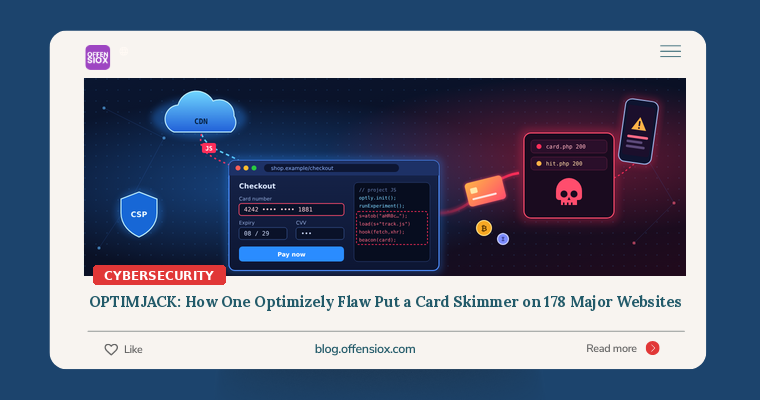
On Monday 16 November 2026, visitors to the BBC, CNN, Zoom, IKEA, HSBC, Salesforce and well over a hundred other household names loaded malware. None of those companies had been hacked in the usual sense. Their servers were untouched, their code repositories were clean and their certificates were valid. The malicious JavaScript arrived through a tool they all trusted: Optimizely Web Experimentation, the A/B testing platform that marketing teams use to try out new headlines, buttons and checkout flows.
An attacker abused a flaw in Optimizely’s account signup flow to write code into customers’ projects. Optimizely’s own CDN then delivered that code, along with the normal snippet, to every visitor. For roughly 16 hours the script swapped cryptocurrency wallet addresses, skimmed card numbers typed into payment forms, took screenshots and cookies, and tried to push exploit kits onto older iPhones. Researcher Scott Helme of Report URI, who found it, summed up the lesson in one line: “trusted JavaScript doesn’t always remain trustworthy.”
If your website loads a single third-party script, and almost every business site loads dozens, this incident is about you too. We covered the business side of this risk two weeks ago after the Plerdy tracker hijack. OPTIMJACK is the same weakness at a far bigger scale, and it gives us hard numbers on which defences actually worked.
TL;DR / key takeaways
- What: A vulnerability in Optimizely Experimentation’s signup flow let an attacker insert malicious code into the “Project JavaScript” field of customer projects. Optimizely’s CDN served it to visitors of at least 178 organisations on 16 November 2026.
- What it did: crypto address swapping, card skimming from on-page forms, cookie and screenshot theft, and delivery of the Coruna and DarkSword iOS exploit kits to older iPhones and iPads.
- Status: Optimizely says the flaw is fixed, injected code removed and affected accounts reset. Helme confirmed every infected file he tracked was clean by late 16 November. Root cause details are still not public.
- What worked: only 24 of the affected organisations (15%) had a Content Security Policy strict enough to block the attack. Hosted payment iframes (Stripe, Adyen and similar) kept card data out of the skimmer’s reach.
- Do now: if you use Optimizely, audit every project’s Project JavaScript and account access. Everyone else: inventory your third-party scripts, keep them off checkout pages, and lock down
script-srcandconnect-src.
What happened
Optimizely Web Experimentation works by loading a JavaScript snippet on every page of a customer’s site, normally from cdn.optimizely.com/js/<project ID>.js. Each project includes a Project JavaScript field: custom code that the customer’s team writes and that runs on every page. It is a powerful feature by design.
According to Optimizely, “an unauthorized party exploited a vulnerability in Experimentation and used it to add malicious JavaScript to some customer projects.” In its status page and customer email, the company said the vulnerability was in the Experimentation account signup flow. CSO Online reports the attack abused a feature for adding members to a site’s development team. Optimizely has not explained how a signup flaw gave write access to existing, unrelated customer projects, and that is the biggest open question.
The attacker left the rest of each snippet untouched and appended a loader to the Project JavaScript. Because the file still came from Optimizely’s CDN with a valid certificate, browsers, firewalls and most security tools had no reason to question it. Sites that serve the Optimizely snippet from their own domain were affected too, since they serve the same project content.
Scott Helme’s team examined 1,611 Optimizely snippets and found malicious code in 188 files belonging to 178 organisations. Named victims across the coverage include Zoom, the BBC, CNN, Fox News, Salesforce, GitLab, IKEA, HSBC, Equifax, Air France-KLM, Ledger, TalkTalk and Optimizely’s own website and login portal. Banks and financial firms were the largest group (32 organisations), followed by technology companies and retailers. Helme believes the real total is higher, because his team only examined the snippets it found in time.
Timeline
All times UTC, compiled mainly from StepSecurity’s reconstruction, which draws on Helme’s data. Sources do not fully agree; see the note below.
- 17 September: The injector domain
webshell[.]lolis first seen. The same injection code had appeared on Turkish websites in September, according to Help Net Security. - 9 November: Three
.icudomains later used for the iOS stage are registered. - 16 November, 04:21: First observed injection, in a BBC snippet.
- 16 November, 05:23: Payload domain
1688360[.]ccis registered. - 16 November, 08:10: The first of 26 builds of the payload
track.jsthat day goes live. - 16 November, 13:43: A payment card skimmer is added to the payload.
- 16 November, 20:40 to 21:10: Mass cleanup of infected projects.
- 16 November, 21:52: One snippet (TalkTalk’s, per The Register) is still infected.
- 16 November, 23:11: Helme reports every tracked file is clean.
- 17 November, 00:37:
1688360[.]ccis placed on registry hold. - 17 November, 04:11 to 05:39: The attacker empties its LTC, ETH, BTC and TRON wallets.
Note on the start time: Optimizely cites 07:51 for the first malicious write, while Helme’s team observed attacker code at 04:21. As analyst Frank Dickson told CSO Online, “Customers need the real start time to scope their exposure.” Until Optimizely publishes a full timeline, use 04:00 UTC on 16 November as the conservative start of your investigation window.
How the payload worked
The loader came in three variants, which matters for detection: a plain script tag pointing to https://1688360[.]cc/track.js, the same URL hidden with base64 and decoded with atob(), and a full inline copy of the payload executed through eval so it kept working even if the domain was blocked. StepSecurity’s analysis of track.js describes four capabilities:
- Crypto address swapper. Holds replacement addresses for ETH, TRX, BTC, TON, SOL, LTC, BCH and DOGE. It only swaps checksum-valid addresses near words such as “wallet”, “deposit” or “send”, and hooks page text, form inputs, copy events, the clipboard API and outgoing
fetch/XHR requests. An address copied from an affected page could be replaced before it was pasted into a wallet. - Card skimmer. Wraps
fetchand XHR and listens for form submissions, looking for Luhn-valid card numbers, expiry dates and CVVs, then sends them to/card.phpwithnavigator.sendBeacon. Crucially, it could not read cross-origin payment iframes. Card details typed into hosted fields from a payment provider were safe. - Screenshots and cookies. After a successful swap it loaded
html2canvas, captured the visible page and posted it to/hit.phpalong with up to 8,000 characters ofdocument.cookie. Cookies markedHttpOnlywere out of reach. - iOS second stage. For iPhone, iPad and iPod user agents it injected further scripts from
.icuhosts. Helme attributes these to the Coruna (iOS 13 to 17) and DarkSword (iOS 18.x) exploit kits plus a separate chain; on iOS 18.6 or earlier, affected pages reloaded every 60 seconds. Hudson Rock said the later stages aimed at keychain data and wallet seed phrases, but neither it nor StepSecurity has confirmed a real device compromise.
Impact so far
The attacker’s wallets received about $7,000 in cryptocurrency, though some of that cannot be tied to visitors of affected sites, and Galaxy Digital’s Alex Thorn estimates closer to $2,300 sent by victims. Card losses are unknown. “We have no way to see how many credit cards were skimmed,” Helme said. Salesforce told Reuters it was investigating “unauthorized modifications to scripts provided by Optimizely” and disabled Optimizely scripts across preview and production instances as a precaution.
Helme assessed the attackers as a small group, likely Chinese, rather than a state actor. Hudson Rock and another researcher also found tampered scripts from Kissmetrics, StorifyMe and minute-ly, with the earliest dating to 13 November, but stressed this does not prove a single operator.
Am I affected?
As a website owner, you are in scope if:
- You use Optimizely Web Experimentation (not just Optimizely’s CMS) on any site, whether loaded from
cdn.optimizely.comor from your own domain. - Your project’s Project JavaScript contained unrecognised code at any point after 04:00 UTC on 16 November.
- Your proxy, CDN, CSP reports or browser telemetry show requests to
1688360[.]cc,webshell[.]lolor the.icuhosts below.
Optimizely says it has notified all affected customers. Do not rely on that alone: verify your own projects.
As a visitor or employee, you may be affected if you entered card details into a site’s own payment form, or copied a crypto wallet address, on one of the affected sites during 16 November. Replace the card, check transfers made that day against the intended destination, and update any iPhone or iPad still on iOS 18.6 or earlier.
What to do: a prioritised checklist
Immediately (today)
- Block the indicators in DNS filtering, web proxies and EDR:
1688360[.]cc,webshell[.]lol, and the.icudomains listed below. - Audit Project JavaScript in every Optimizely Web project you own. Search for the domains, but also for
atob,evaland long base64 strings, because two of the three variants hide the URL. - Review account access: list every user and API token on your Optimizely account, remove anything you do not recognise, and ask Optimizely which of your projects were modified, when, and by which accounts.
- Search logs back to 04:00 UTC on 16 November for the indicators (queries below).
- Notify your payment provider and legal team if your checkout uses on-page card fields and an affected snippet ran there. Card data captured from your own form fields may trigger breach obligations.
This week
- Inventory every third-party script on your site, with an owner and a business reason for each. Remove what nobody can justify.
- Keep third-party tags off checkout and login pages. A/B testing, analytics and chat widgets rarely need to run where people type card numbers or passwords.
- Move card entry into your provider’s hosted fields or hosted payment page. In this incident, that single decision kept card data out of the skimmer’s reach.
- Deploy or tighten CSP, starting in report-only mode, with tight
script-srcandconnect-srcallowlists and no'unsafe-eval'where you can avoid it.
Longer term
- Treat marketing tools as code deployment tools. Anyone who can edit an experiment’s custom JavaScript can deploy code to production. Apply MFA, least privilege and change review accordingly.
- Monitor what your pages actually load with CSP reporting or a client-side script monitoring service, so a new outbound domain triggers an alert within minutes, not days.
- Write vendor terms that require prompt notification and a full root-cause timeline after incidents like this one.
Detection and hardening snippets
Check your Optimizely snippet
Replace the project ID with your own. This only shows what is being served right now, so also check the Project JavaScript history in the Optimizely console.
PROJECT_ID~|=|1234567890   ~|#| your Optimizely project ID
curl ~|-|s "https://cdn.optimizely.com/js/${PROJECT_ID}.js" ~|-|o optly.js
grep ~|-|nE '1688360|webshell\.lol|\.icu/|track\.js|card\.php|hit\.php' optly.js
~|#| Hidden variants: review every match by hand
grep ~|-|noE 'atob\(|eval\(|[A~|-|Za~|-|z0~|-|9+/]{120,}~|=|{0,2}' optly.js | head ~|-|50
Hunt in proxy or DNS logs
Splunk (adjust index and field names to your proxy data):
index~|=|proxy earliest~|=|"11/16/2026:04:00:00"
  (url~|=|"*1688360.cc*" OR url~|=|"*webshell.lol*" OR url~|=|"*/JIUJIU888/*"
   OR dest_host IN ("eil786npto9u5bq.icu","1y69gy2mdzaltz1.icu","gm38duxoihbmy5o.icu",
                    "5vobauua3ojpklx.icu","p55abnw2pnsz0bo.icu","je4ft3gn8vxudum.icu",
                    "l7bcsnwc7nzr3uo.icu","q1ls1ho9x7wsxlu.icu","ios~|-|hack.icu"))
| stats count min(_time) as first max(_time) as last by src_ip, user, dest_host, url
Microsoft Defender for Endpoint (KQL):
let iocs ~|=| dynamic(["1688360.cc","webshell.lol","eil786npto9u5bq.icu","1y69gy2mdzaltz1.icu",
  "gm38duxoihbmy5o.icu","5vobauua3ojpklx.icu","p55abnw2pnsz0bo.icu","je4ft3gn8vxudum.icu",
  "l7bcsnwc7nzr3uo.icu","q1ls1ho9x7wsxlu.icu","ios~|-|hack.icu"]);
DeviceNetworkEvents
| where Timestamp >~|=| datetime(2026~|-|11~|-|16T04:00:00Z)
| where RemoteUrl has_any (iocs) or RemoteIP in ("136.113.106.136","34.87.36.58","34.96.213.201")
| project Timestamp, DeviceName, InitiatingProcessAccountName, InitiatingProcessFileName, RemoteUrl, RemoteIP
A Content Security Policy that would have helped
Of the affected organisations, 68 had no CSP and 50 had a policy that still let the malware load and send data out. Allowlisting Optimizely’s domain alone did not help, because the loader came from that domain. What blocked the attack was a host allowlist that did not include the attacker’s domains, for both loading scripts and sending data. An illustrative starting point, which you must adapt to your own vendors:
Content~|-|Security~|-|Policy~|-|Report~|-|Only:
  default~|-|src 'self';
  script~|-|src 'self' https://cdn.optimizely.com https://js.stripe.com;
  connect~|-|src 'self' https://logx.optimizely.com https://api.stripe.com;
  frame~|-|src https://js.stripe.com;
  object~|-|src 'none'; base~|-|uri 'self';
  report~|-|to csp~|-|endpoint
Three points from the incident analysis:
script-srcallowlisting would have blockedtrack.js;connect-srcallowlisting would have blocked exfiltration tocard.phpandhit.phpeven if the inline variant ran.- A
'strict-dynamic'policy with a nonce does not stop scripts that a trusted script adds, so it would not have stopped this loader. 'unsafe-eval', which Optimizely’s documentation recommends for some features, let the inline backup copy run on HSBC’s site. Drop it if you can, or at least keep it off pages that handle payments or logins.
Subresource Integrity (SRI) is a poor fit here, because Optimizely snippets change every time an experiment is published.
Indicators of compromise
From StepSecurity’s analysis and Scott Helme’s research (defanged). Match on behaviour and domains rather than file hashes, since the payload was rebuilt 26 times.
| Type | Indicator |
|---|---|
| Payload / exfil domain | 1688360[.]cc (paths /track.js, /card.php, /hit.php, /html2canvas.min.js) |
| Injector domain | webshell[.]lol (/get.js) |
| iOS stage domains | eil786npto9u5bq[.]icu, 1y69gy2mdzaltz1[.]icu, gm38duxoihbmy5o[.]icu, 5vobauua3ojpklx[.]icu, p55abnw2pnsz0bo[.]icu, je4ft3gn8vxudum[.]icu, l7bcsnwc7nzr3uo[.]icu, q1ls1ho9x7wsxlu[.]icu, ios-hack[.]icu |
| iOS paths | /boot.js, /JIUJIU888/weifile.html, /JIUJIU888/index.js, /A8/a.html |
| IPs | 136.113.106.136, 34.87.36.58, 34.96.213.201 |
| Browser artefacts | window._k7, window._cc, window._qxc, window._shot; sessionStorage keys starting cc_ |
| BTC wallet | 19g9rZcPeiz8rUvyWpTRyXXhPnjsWrc3kW |
| ETH/BSC wallet | 0xC4026b06D82b0F0B363eda0642D61CfbDc17884e |
| TRX wallet | THvs6p56XkUiMkJeSc51cAP64u2RsTYqxa |
| LTC wallet | ltc1q3wp7g6ds0ggg6fl6kncpa4sepn0q3qfacgred5 |
StepSecurity’s write-up also lists TON, SOL, BCH and DOGE replacement addresses and partial file hashes.
OffensioX perspective
OPTIMJACK follows a pattern we keep seeing: polyfill.io in 2024, Plerdy earlier this month, and now Optimizely. Attackers have worked out that the cheapest way into thousands of websites is not to hack the websites, but to hack the one vendor whose code they all load without question. The striking statistic here is not 178 victims. It is that only 15% of them, including some of the best-resourced security teams in the world, had a browser-side policy that would have stopped a script loading from a domain registered that same morning.
For e-commerce businesses in Pakistan and across South Asia, the lesson is practical and cheap to act on. Many local stores still collect card details in their own forms, load marketing tags on the checkout page and have no CSP at all. Move card entry to your payment gateway’s hosted page or fields, strip non-essential scripts from checkout, and switch on a report-only CSP this week so you can see what your pages really load. Also review who can edit custom code in your marketing and analytics tools, because that access is now a production deployment right.
If you want an outside view, OffensioX’s penetration testing and web application assessments include a review of third-party scripts, CSP and payment-page exposure, so you can find these gaps before an attacker does.
References
- BleepingComputer: Optimizely hack infected CNN, Fox News, BBC, Salesforce sites with malware
- StepSecurity: OPTIMJACK: Optimizely-Hosted Scripts Loaded a Crypto Clipper and Card Skimmer on 178 Organizations
- Help Net Security: Malware spread through Optimizely hits 178 organizations, including BBC, CNN and Zoom
- CSO Online: Optimizely confirms massive cyberattack on customer websites injected stealer malware
- The Register: Optimizely hack turns world’s biggest websites into malware dispensers
- Scott Helme on X: initial disclosure
- Optimizely Support: Update your site’s Content Security Policies (CSP)
- Scott Helme: Warning users of the polyfill.io supply chain attack
- OffensioX: Poisoned Trackers: What APT29’s Plerdy Hijack Means for Your Business